Hawaii's Floating City Development Program, First Annual Report, Fiscal Year 1972
First annual report of a University of Hawaii and Oceanic Institute program to design a floating urban platform, dated August 31, 1972. 50 pages covering systems integration, environmental analysis, scale model research and preliminary engineering.
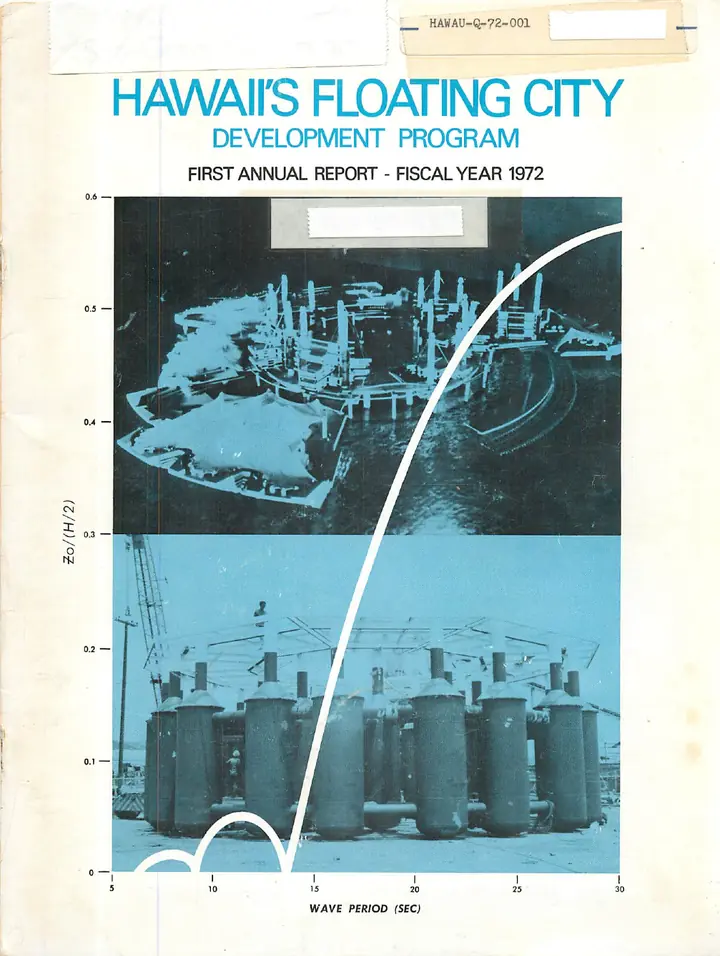
The preface calls American urban development a "fruit and nut cake" mixture of private and public capital, and proposes that cities be designed as whole systems, the way defense and space hardware had been. The program that follows, run by John Craven at the University of Hawaii with the Oceanic Institute and funded in part through NOAA's Sea Grant office, set out to design one that floats.
The overview builds a lineage. E. R. Armstrong's Seadrome came in 1922. The Navy and the oil industry showed in the mid-1950s that man-made islands could stand in tens of fathoms of water, and by the 1960s drilling rigs rode semi-submersible hulls that ignored surface waves. The authors argue Hawaii and Japan would get there first, since both are island societies short of land.
The remaining chapters are results from the first fiscal year: wave-period charts, scale model research, preliminary engineering, and a financial summary. The overview's case rests on stability: platforms whose mass sits below the turbulent surface zone, with only thin columns passing through it.
Provenance
- Original source
- https://repository.library.noaa.gov/view/noaa/42324/noaa_42324_DS1.pdf
- Collected
- This copy
- 7.7 MB · 50 pages · archived here
- Rights
- Work of the US federal government, not subject to copyright (17 U.S.C. 105).
- SHA-256
11c2a07bd1c0c75a706dd29126cd1cf0ca57e78ff82ae1be470f2a1ddaf223bb
Accession № 0076. If you hold rights in this and would rather the copy did not exist, say so and it comes down.