Project Crested Ice: The Thule Nuclear Accident, Volume I (SAC Historical Study #113, 1969)
On 21 January 1968 a B-52 carrying four hydrogen bombs caught fire and went into the sea ice off Thule, Greenland. A year later Strategic Air Command's own historians wrote up the three-month cleanup: 82 pages on how you collect plutonium off Arctic sea ice in winter.
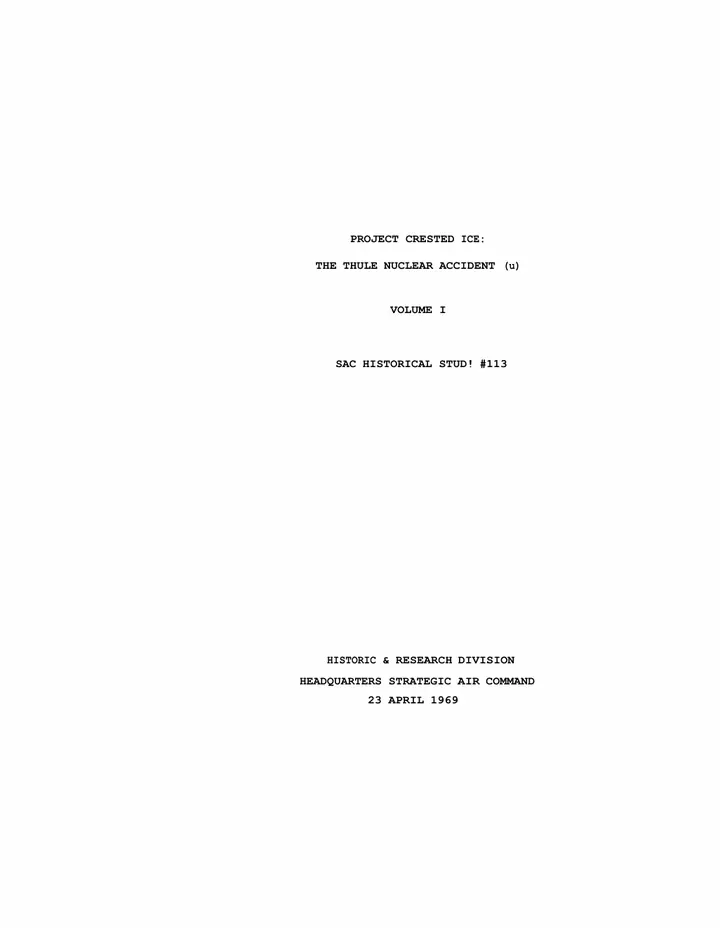
A B-52 caught fire over Baffin Bay on 21 January 1968 and went into the sea ice seven miles from Thule Air Base, carrying four hydrogen bombs. The high explosive in all four detonated on impact without a nuclear yield, which spread plutonium across the ice rather than across Greenland.
Strategic Air Command wrote this a year later, for its own historians. The foreword sets the scope:
This study is concerned with the USAF recovery and decontamination effort precipitated by the crash of a B-52G near Thule, Greenland, on 21 January 1968. It is largely the story of Strategic Air Command's Disaster Control Team during the three-month period of Project Crested Ice.
So most of what follows is about running a decontamination operation in an Arctic winter. Where the men slept. How you move a vehicle over ice that is being scarified and drummed. What happens to the drums afterwards. There are appendices on the organisation chart of the Disaster Control Team and on the route the Thule monitor took across the ice.
Provenance
- Original source
- https://www.governmentattic.org/61docs/USAFprojCrestedIceThuleNukeAccident1969.pdf
- Collected
- This copy
- 4.0 MB · 82 pages · archived here
- Rights
- Work of the US federal government, not subject to copyright (17 U.S.C. 105).
- SHA-256
f134b4bfc95c3585b60bdf8e2b52098848e99d9befbde1b7c4bdad583f000638
Accession № 0001. If you hold rights in this and would rather the copy did not exist, say so and it comes down.